
Developers, rejoice. The days of acting as unpaid interns for your AI—copying, pasting, praying—are finally over. A new breed of autonomous coding agents is smashing the “code ping-pong” curse and rewriting the rules of modern software development.
💥 The Copy-Paste Circus Is Over
If you’ve ever bounced between a chat window and your IDE like a caffeinated squirrel, you know the pain:
AI spits code → compiler screams → you copy errors → AI apologizes → repeat forever.
This manual glue-work is the single biggest productivity tax in AI-assisted coding. But not for long.
🤖 Autonomous Agents Close the Loop
The new wave of LLM-powered agents don’t just write code—they run it, catch the failures, and fix themselves.
They:
- Execute your tests
- Capture the exact terminal or IDE errors
- Feed that back into the model
- Iterate without you
This isn’t chatbot territory.
This is AI that actually works while you think.
🖥️ Cursor: The IDE Speed Demon
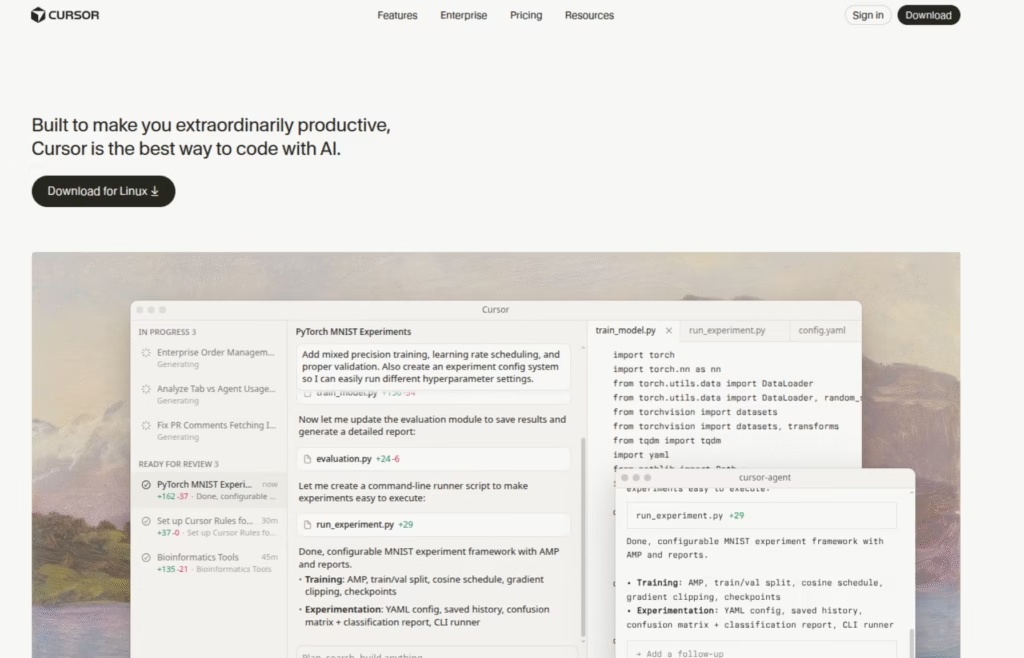
Cursor is the AI-native IDE built on VS Code—and it’s the current commercial king of “don’t lift a finger.”
⚡ Why Devs Swear By It
- Auto-captures linter and TypeScript errors
- Feeds IDE warnings directly into the model
- Nails multi-file refactors
- Rarely gets stuck in loops
- Blazing visual feedback
Cursor’s Agent Mode basically turns your IDE into a robotic co-worker that never sleeps.
🧰 Aider: The Terminal Tactician
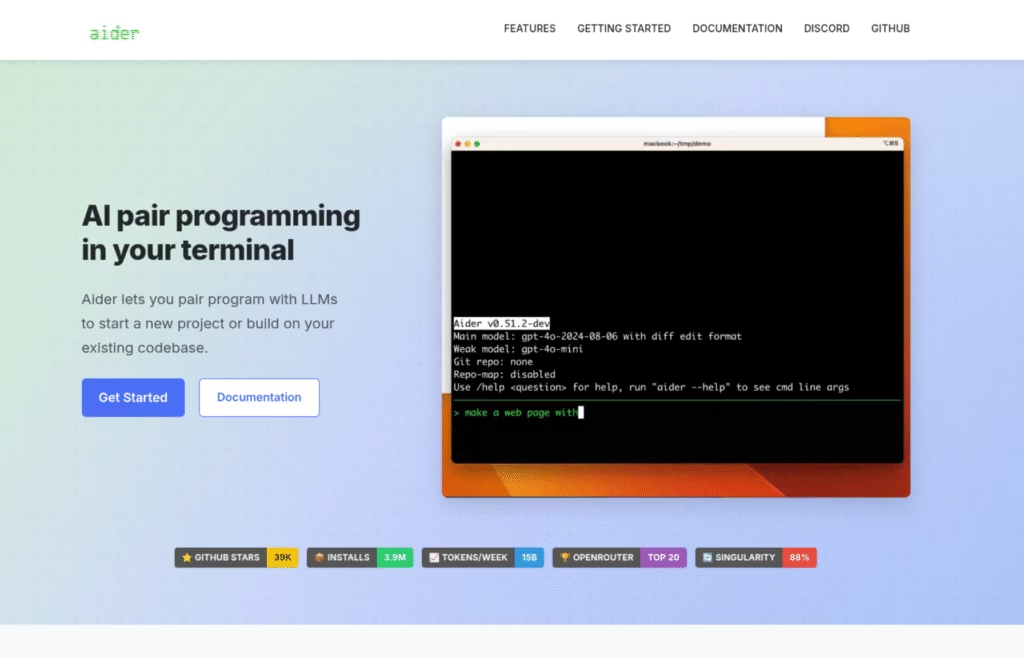
For the command-line purists, Aider is the gold-standard open-source agent.
🎯 Why Terminal Veterans Love It
- You set the build/test command
- Aider reruns it after every change
- Raw terminal errors go straight into the model
- Every fix becomes a clean Git commit
- Model-agnostic: plug in whatever LLM fits your budget
It’s disciplined, Git-first, and deadly precise—perfect for engineers who treat their terminal like a dojo.
💸 The Secret Power-Up: Smarter, Cheaper LLMs
The agent is only as clever as the brain behind it.
Enter Z.ai’s GLM-4.x series, the budget-friendly wrecking ball:
- Near-Sonnet 4.5 performance
- Dirt-cheap token pricing
- Massive context windows (up to 205K)
- Designed for agentic tasks
Pairing Aider with GLM-4.x is the hacker’s paradise:
fast loops, tiny bills, no token anxiety.
🏁 The Bottom Line: Stop Being a Copy-Paste Robot
Whether you prefer Cursor’s buttery IDE integration or Aider’s Git-discipline, one truth stands:
👉 Autonomous loops are the future.
👉 Your time is too valuable for error-shuttling.
Let the machines handle the grunt work while you architect the big stuff.
🔧 Aider vs. Cursor: The Tabloid Throwdown
The CLI purists vs. the IDE speed freaks—it’s a war of philosophy as much as workflow.
⚔️ Two Worlds, Two Tools
Aider = The Git Monk
Minimalist. Terminal-native. Total control.
Every patch is reviewable. Every model is swappable.
Cursor = The Fast & Furious IDE
Instant refactors. Massive context infusion.
Project-wide awareness. Blink-and-it’s-done velocity.
No wrong answer—just different mindsets.
🧪 Aider Deep Dive: The Git Engineer
Perfect for:
- Monorepos
- Strict review flows
- Budget-conscious teams
- Devs who measure time in commits
Aider keeps things clean, transparent, and controlled—like pair-programming with a robot that respects Git more than life itself.
⚡ Cursor Deep Dive: The Velocity Specialist
Perfect for:
- Rapid prototyping
- Multi-file chaos
- Fixing all red squiggles… immediately
- Teams who value speed above ceremony
Cursor’s Background Agent is quickly becoming industry-standard—it just gets things done.
💰 Cost Is the Silent Killer
Autonomous loops eat tokens.
That’s why GLM-4.5 and 4.6 are exploding in popularity:
- Ultra-low input/output cost
- High agentic success rates
- Up to 400K context windows
For Aider users, that’s basically unlimited debug loops for pocket change.
🧭 Recommendation
- Pick Aider if you worship Git, live in the terminal, and want total control for cheap.
- Pick Cursor if you want speed, visual feedback, and the smoothest IDE experience on the market.
There’s no universal winner—only the right tool for your style.
🤖 Devin’s Legacy: The 2025 State of AI Software Engineers
Devin lit the fuse. The industry is still chasing the explosion.
🌐 The Dream: Issue → PR, All Autonomous
Devin promised the full-stack fantasy:
- Read the issue
- Research the docs
- Write the code
- Run the tests
- Open the PR
That “plan–act–reflect” loop is still the holy grail.
🧬 Open Source: SWE-Agent & OpenDevin Take Over
SWE-Agent
A structured beast.
Crushes real-world bug benchmarks with its rigorous ACI system.
OpenDevin
A sandboxed playground for research—bash, browser, filesystem, everything.
These projects are dragging autonomy into the public domain.
💼 The Commercial Crowd: Jules & Cline
Cloud-based, autonomous, always-on coding assistants.
Jules (Gemini-powered) is winning love for:
- Deep code reading
- Test writing
- Bug fixing
- Full issue-to-PR workflows
Cline leans heavily on GLM-4.x—and the results show.
🧠 The Gatekeeper: LLM Smarts
Autonomy hinges on:
- Planning
- Tool use
Claude Opus still dominates planning.
GLM-4.6 dominates tool calling.
Meanwhile, Goldman Sachs and other giants are piloting Devin to overhaul internal development pipelines. This is no longer theory.
🎬 Are They Ready for Your Production Repo?
Yes… and no.
They excel at:
- Bug fixes
- Refactors
- Repetitive, mechanical tasks
They still need humans for:
- Architecture
- New feature design
- Strategic judgment
But the future?
A hybrid team—human architects, AI builders—is already here.
🧾 Bottom Line
Autonomous coding agents aren’t hype—they’re here, they’re sharp, and they’re saving developers hours of brain-melting grunt work.
Stop babysitting your tools.
Start letting them code.
📚 Quick Backstory
Cursor: Launched as an AI-first VS Code fork focused on speed, deep project understanding, and seamless integration.
Aider: Open-source terminal-native agent built with Git discipline at its core, model-agnostic and popular with power users.
GLM-4.x (Z.ai): A rising LLM family optimized for agent workflows—huge context windows, low cost, strong tool-usage reliability.
Devin: The first widely publicized “autonomous software engineer,” sparking the arms race of 2024–2025.
SWE-Agent & OpenDevin: Open-source successors leading structured autonomy and research innovation.
Jules & Cline: Commercial entrants delivering cloud-based, always-on coding companions.
If you want variations—Forbes-style, LinkedIn-friendly, press-release format—just say the word.